Letter from the dais
Dear Delegates,
My name is Jane Irons and I am a junior in Ezra Stiles College. It is my pleasure to welcome you all to SCSY 2017 for what I hope will be an interesting, challenging, and educational committee: The Delian League. I find the Delian League, and ancient Greece in general, to be particularly engaging topics because they are so removed from our current political environment, but relevant just the same because of the lessons they can teach us about how patterns in alliances and international relations operate throughout history. The Delian League is one of the earliest alliances documented in the style of "scientific history," of which Athenian historian Thucidydes was the father, meaning the accounts of it contain some of the earliest iterations of international relations theories that we have. I also have ancestors from the Peloponnese, where one of the Delian League's major wars was fought, so the subject has personal significance to me. I hope you are excited to engage in the crises that will arise in our committee and learn more about ancient Greece.
Besides chairing for SCSY, I am on Yale’s model UN team and the Yale Debate Association, where I do parliamentary forms of debate and serve as an equity officer to resolve conflicts and ensure there is no discrimination on the team. I have also been involved with Mind Matters, our mental illness awareness and advocacy group. I am a philosophy major and hope to either go into law or become a fiction writer.
I am looking forward to engaging in informative and interesting debates in this committee with all of you. Until then, feel free to email me at jane.irons@yale.edu with any questions. Good luck in your preparation, and I will see you soon!
Best,
Jane Irons ES '19
Dear Delegates,
My name is Viktor Dimas, and I am a sophomore in Davenport College. I am delighted to have the opportunity to serve as your chair in the Delian League Committee of this year’s Security Council Simulation at Yale.
Being an international student from Athens, Greece I have repeatedly been exposed to the history of the Peloponnesian War; in fact, growing up in Greece it is very difficult to disassociate oneself from these events that seem so close, but are actually very distant. Of course Spartan warriors may not be training around you walking in the streets of modern-day Sparta, Pericles may not be speaking when you go for coffee with your friends in the centre of Athens, and I promise modern Greece does not look even half as wealthy as Athens during the years of the Delian league; however, all this history makes its presence evident in a very peculiar manner. Listening to Donald Trump talking about his vision of the NATO, experiencing phenomena of intense polarization in international relations, and making an effort to understand the situation in the Middle East, I find it almost impossible not to think about the events of the Peloponnesian War. My hope for this committee is that it will become an effort to immersively understand such parallels between the distant past and the present.
SCSY is one of the two YIRA conferences I will be helping out with this Fall, the other one being YMUN. Being very passionate about Model UN and International Relations I am sure this is only the beginning of my involvement with YIRA. This year I am also involved with the Yale Hellenic Society, serving it as its Political Chair, and the Yale UNICEF Chapter, being its Publicity Director. Academically, even though I am still uncertain about my major, I am really interested in Political Science and Philosophy.
I am looking forward to meeting each one of you in person. I cannot hide my excitement about the subject matter of our committee, which as challenging as it may be, has the potential to make a series of very interesting sessions. If you have any questions, feel free to contact me at viktor.dimas@yale.edu. Good luck with your preparation!
Best,
Viktor Dimas DC ‘ 20
Topic history
In approximately 478 BC, seeking revenge against Persia for their invasion of Greece, over 150 ancient Greek city states each dropped iron ingots in the sea to symbolize what they hoped would be a permanent alliance. Athens quickly emerged as a hegemon, demanding tribute from other members and crushing rebellions, even going so far as attempting to order the death of the entire male population of Lesbos. Athens’s place was threatened in 431 BC when war broke out with the Spartan-led Peloponnesian League in what is called the Peloponnesian War. Faced with both threats from the Spartans and rebellions within the League itself, the Delian League and its members are threatened with extinction. Delegates from Delian League members will come together to keep their alliance from being crushed by the Spartans and keep the alliance from crumbling from within.
Current Situation
431 BC marked the beginning of the 2nd Peloponnesian War, also referred to simply as the Peloponnesian War, fought between Athens and Sparta with the help of their large networks of allies. Sparta and its allies formed the Peloponnesian League, while Athens and its allies were the Delian League. Several minor conflicts and revolts prior to 431 BC led the Peloponnesian League to declare war. First was the Corinth-Corcyra war, which began as a conflict between Corcyra and its colony Epidamnos. Corinth, a Spartan ally, was another major power at the time, though not on the scale of Sparta and Athens. Corinth supported Epidamnos and Athens sided with Corcyra. Athens and Corinth fought at the naval battle of Sybota in 433 BC. Both sides claimed to have won the battle, but Corinth abandoned its campaign soon after.
432 BC marked the revolt of Potidaea, a city that was a colony of Corinth but part of the Athenian Empire. Athens demanded that Potidaia cut ties to Corinth, but the Potidaeans refused and requested assistance from Sparta. Sparta proclaimed that if Athens attacked Potidaea, they would invade Attica, which led the Potidians to begin to revolt.
The next conflict was over Megara, a city that had been allied with Athens until 446 BC but had switched over to the Spartan side. In response to Megarian participation in the Corcyra conflict, Athens announced the Megarian decree, which forbid Megara from using Athenian harbors and markets.
The Spartan assembly met to decide on the proper response to Athenian actions. The assembly ended up voting for war, and when the issue was brought to the Peloponnesian League as a whole, the league voted that Athens had indeed broken the terms of the Thirty Year’s Peace. Sparta sent an embassy to Athens in an attempt to preserve peace, but the attempt failed, leading to war.
The Thirty Years’ Peace was an agreement between Athens and Sparta signed in either 445 BC. It ended the First Peloponnesian War, which started in 460 BC. The agreement forced Athens to give up several territories including Megarian ports. The agreement also stated that Athens and Sparta would avoid going to war over territory if one of the two wanted arbitration. Cities that had been previously unaffiliated with either power were allowed to join either side.
Athens and Sparta had been allied just twenty years before the First Peloponnesian War began. The two cities fought against the Persians in the Greco-Persian Wars, which ended in the Greeks successfully defeating most of the Persian forces by 449 BC. At the time, Sparta was the most powerful city, but major Greek naval powers - including Athens - that took the lead in waging war against Persian territories in Asia and the Aegean grew resentful, leading Sparta to abandon its leadership position after 478 BC. After the wars, Athens began to rebuild its walls and strengthen its naval capabilities, leading Sparta to worry that Athens was becoming too powerful.
Athens continued building its walls in secret against the express wishes of Sparta and began consolidating power in 479 BC. At this point, Athens had taken primary control of campaigning against the Persians in the Aegean. In the winter of 479-478 BC, the Athenians took leadership of the newly formed Delian League. After the walls were completed, Athenian leader Themistocles declared Athens independent of Spartan power and said the city was capable of defending itself without assistance. However, Themistocles was forced to flee to Persia in the early 470s. Cimon, who advocated for cooperation between Athens and Sparta, rose to power.
Simultaneously, the Athenian empire continued to grow. Athens conquered all of Greece except Sparta and its allies. It reduced several of its former allies to merely tribute-paying subjects of the Delian League. Athens used the tributes to support a powerful fleet and fund massive public works programs in Athens, including the building of the Parthenon, which led to resentment and accusations that Athens was no longer acting in the interest of the entire league. Cimon forced more and more cities to become members of the League. Athens’s aggressive foreign policy was in part attributed to the fact that it was a democracy and thus made more reckless decisions without the guidance of experts. Athenians grew used to a high standard of living due to the funding they received from member states.
In the mid-460s BC, Sparta reportedly intended to invade Attica, the territory in which Athens was situated, but was prevented from doing so by an earthquake. The destabilizing effects of the earthquake led the Spartan helots, a large percentage of the Spartan population that was forced to do slave labor, to revolt. Sparta called for assistance from all of its allies, and Athens responded, sending 4,000 men led by Cimon. Though it is unclear what exactly occurred, Spartans ended up dismissing the Athenians, embarrassing Cimon and leading to his ostracism. Athens helped settle the helots who had been exiled after their revolt was crushed and ended up at war with Corinth and several other Peloponnesian states, leading to the outbreak of the First Peloponnesian War.
Athens had a string of successes during the beginning of the war, but their forces were spread thin, as they were also involved in Egypt, where they were assisting in a revolt against Persian king Artaxerxes. The Persians destroyed the Athenian forces, hurting Athens’s control of the Aegean. Athens spent several years reorganizing the Delian League and attempting to stabilize the region. Cimon returned to Athens in 451 BC, and the Athenians were willing to let him negotiate a 5-year truce with Sparta. War broke out again, but was ended by the Thirty Years’ Peace, which was in turn ended by the 2nd Peloponnesian War. The war began with Sparta repeatedly invading Attica with its superior land power, while Athens raided the coast of the Peloponnese with its superior naval power.
At the time, the Delian League was set up such that Athens was the leader and member states were expected to give monetary tribute or ships, timber, or grain. Trade was facilitated amongst the cities and piracy was combated. Several cities tried to secede, such as Naxos in 467 BC. Naxos saw no reason to continue contributing to the League now that the Persian threat had been diminished. Athens attacked the island in order to keep its resources, forcing it to become dependent. Thasos also attempted to take control from the Delian League, as it wanted to maintain authority over its mines and trade centers. Athens laid siege to the city for three years, and Thasos capitulated. Only Chios, Lesbos, and Samos were allowed to remain autonomous. After the revolts, Athens dominated subject states and made them act as Athenian puppets in the league’s assembly. The subject states’ votes overwhelmed the votes of other smaller states, making the league essentially a facade because every decision was entirely controlled by Athens. Athens imposed constitutions modeled on its own onto allies and forbid them from making major political decisions without its approval. Athens would also exploit religion and idealism, claiming land on the basis that it had belonged to Athena. Athens often supported democratic regimes against oligarchical ones, but would occasionally also support oligarchical regimes when in its interest. Athens was, however, dependent on other Delian League members for resources like food and timber, which were necessary for the survival of its citizens.
At the beginning of the war, the major issues the league faced therefore were potential revolts, disagreement over tributes and trade, and strategies to use against Sparta. The balance Athens had to strike regarding taking tribute from cities without leading them to revolt became even more delicate because they need more funding to fight the Peloponnesian League. Athens also had to make sure that other cities did not switch over to the Spartan side. It is up to each city to decide whether the potential costs of revolt and the concrete costs of war are outweighed by the benefits afforded by Delian League membership.
The committee will take place in 429 BC, the 3rd year of war. At the very beginning of the war, the Athenians moved their goods from the country to the city for protection. Because Athens was associated with empire while Sparta was associated with freedom, most cities with a choice sided with the latter. However, many of the islands and coast-towns of Asia and the Northwest were largely controlled by Athens, and Plataea, Naupactus, and the Acarnians were indebted to Athens for various reasons, leading these groups to side with Athens. There were a few other important developments from 431 to 429 BC: the first and second Spartan invasions of Attica, several naval missions by Athens, and alliance formations.
The first invasion of Attica turned out badly for the Spartans, largely due to poor planning and lack of clear goal. Spartan King Archidamus hoped that sending a large army would intimidate Athens into surrender, or at least entice them into battle, but Athenian statesman Pericles convinced his fellow citizens not to take the bait and only sent one or two squadrons to protect the area immediately around the city. Sparta invaded Attica for the second time in 430 BC, and appeared to be having more success than it did the first time.
Meanwhile, Athens was attempting to take control of several cities with its navy. Athens took Aegina and Cephallenia. Pericles led an invasion of the Megarid, the area where Spartan ally Megara was situated, with nearly the entirety of the Athenian forces. Afterwards, Pericles led a fleet of one hundred ships to attack the coasts of the Peloponnese. The first attack, on Epidaurus, failed. Athens also allied with Thrace. Several other skirmishes over various territories occurred.
In addition to the general problems the Delian League faces throughout the war that were outlined previously, the league faces a unique set of problems in 429 BC. It must decide how to deal with the second invasion of Attica, including the siege occurring at Athens. It must decide where to allocate troops: options include continuing the naval assault on the Peloponnesian coasts, focusing on saving Athens, and taking other territories. It must also decide whether to attempt to negotiate with Sparta. Several allies may be considering revolting, so the league has to formulate an idea of what costs it is willing to incur to pacify or force allies to stay, or whether it is willing to allow countries to leave the alliance.
It is useful to know the military tactics that were available to the Delian League at the time. The league’s primary advantage was in naval warfare. Fleets were mostly made up of triremes, which were powered by a core of professional rowers. Each trireme was equipped with a bronze ram at the bow, which was mostly used to ram enemy ships. It could also be used to shear off the oars of other ships, removing their mobility. A few archers were also present on triremes.
Sparta had the advantage in land warfare and had a professional army. Athens’s army was made up of ordinary citizens. There were three types of troops: cavalry, hoplites, and light-armed troops called peltasts. Cavalry were usually rich citizens who could afford to keep horses. They only carried spears, and since stirrups had not been invented, they were easily unseated. Hoplites were the central fighting force. They carried heavy shields and either spears or swords. Athens did not make significant use of the peltasts, who were drawn from the poorest citizens and usually used bows and arrows, javelins, or slings.
Siege warfare was also an option. Many cities began building walls around themselves to protect from invaders. The main strategy of sieges was to starve the enemy into submission by trapping everyone inside the walls and not allowing any resources to come in. Occasionally, the city was directly attacked with weapons such as flamethrowers.
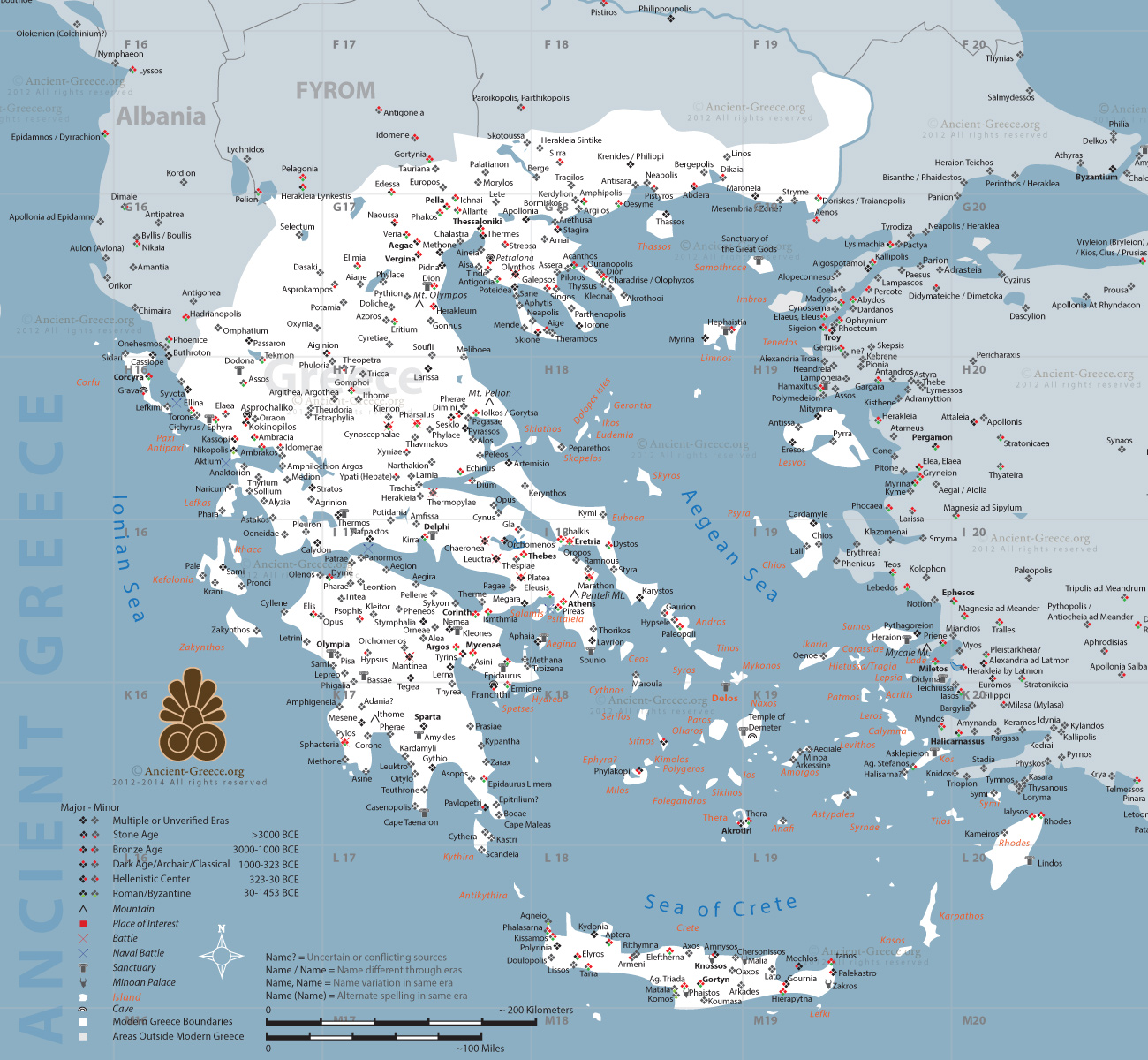
Below: A useful map of ancient Greece (click the hyperlink for an enlargeable version). Sparta is near the mid/bottom left next to the key. Athens is closer to the middle, above the islands between the Aegean Sea and the Sea of Crete, and to the left of the Aegean Sea. There is a list of allies after the map for clarification as to what Sparta or Athens would reasonably be attacking and for strategic planning of transport and travel routes.
List of Allies (directly quoted from Thucydides):
Sparta: “all the Peloponnesians within the Isthmus except the Argives and Achaeans, who were neutral; Pellene being the only Achaean city that first joined in the war, though her example was afterwards followed by the rest. Outside Peloponnese the Megarians, Locrians, Boeotians, Phocians, Ambraciots, Leucadians, and Anactorians. Of these, ships were furnished by the Corinthians, Megarians, Sicyonians, Pellenians, Eleans, Ambraciots, and Leucadians; and cavalry by the Boeotians, Phocians, and Locrians. The other states sent infantry. This was the Lacedaemonian confederacy.”
Athens: “the Chians, Lesbians, Plataeans, the Messenians in Naupactus, most of the Acarnanians, the Corcyraeans, Zacynthians, and some tributary cities in the following countries, viz., Caria upon the sea with her Dorian neighbours, Ionia, the Hellespont, the Thracian towns, the islands lying between Peloponnese and Crete towards the east, and all the Cyclades except Melos and Thera. Of these, ships were furnished by Chios, Lesbos, and Corcyra, infantry and money by the rest.”
Portfolio Powers
Athens - Pericles
Role: Leader of the Delian League
Description: With the second invasion of Attica by the Spartans happening in 429 BCE, Athens is in a very difficult position. The unstable alliances of the city-state with the other members of the Delian League complete the picture of the crisis Athens is going through. Even in that position, however, Athens maintains some very loyal allies and a very strong naval force, able to impose its dominance. The city needs to decide how to allocate its resources, in order to deal with the immediate Peloponnesian threat and secure its leadership over the Delian League.
Portfolio Powers: As the leader of the Delian League, Athens has full control of the alliance’s finances (since the treasury is located in the city) and the command of its naval forces (since its vast majority is athenian). Additionally, Athens’ stable political situation ensured by its gifted general, Pericles, allows for thoughts of diplomatic solutions to the situation with Sparta, without putting the leadership of the League at risk.
2. Corcyra - Peithias
Role: Member of the Delian League
Description: Corcyra is one of the stronger members of the League, as along with Lesbos and Chios, they contribute to the league militarily. This adds to its power within the alliance, since it can potentially resist any decision done against its will. In general the island is very supportive of Athens. However, due to the release of a population of Corcyrean prisoners by Corinth (an ally of Sparta) on the condition that they would make an effort to change the status quo on the island, makes Corcyra quite unstable politically in 429 BCE.
Portfolio Powers: The democratic sentiment of the majority of Corcyreans makes the island very favorable towards Athens. Corcyra has been benefited by the League, having increased its power in Greece. The stance of Corcyra regarding the assistance of Athens, as well as the nature of that assistance greatly depends on the fears of domestic political issues, that may need the presence of the alliance’s forces in the island.
3. Chios - Daedalus*
Role: Member of the Delian League
Description: Chios is an island of the Eastern Aegean. One of the very close allies of Athens within the League, and of the three islands that were contributing militarily to its purposes. Chios had helped the Athenians both in their military and diplomatic endeavors. In 429 BCE a group of people start becoming more favorable towards Sparta. The island, for reasons of ensuring its security, starts the construction of a wall, a move which the Athenians disapprove of, thinking it is a sign of a revolution being planned.
Portfolio Powers: Chios needs to set its priorities straight. The island has to decide whether the relations with Athens are more important than defensive self-sufficiency. If they are, the island also needs to decide how to support Athens in order to regain the trust of the superpower. If not, the islands has to start looking for strategic alternatives, on the possible occasion of athenian aggressions.
4. Zacynthus - Kadmos*
Role: Member of the Delian League
Description: Zacynthus is an island in the Ionian sea. It was one of the important members of the League because of its strategic position close to the Peloponnese and other locations of importance for the war. However, it was not one of the members that contributed militarily. Zacynthus would pay the tribute to the league financially. In general, it was one of the members of the League most loyal to Athens.
Portfolio Powers: In 429 Zcynthus finds itself in a position which appears to be pretty settled in support of the Athenian interests. The situation Athens finds itself and the strategic importance of Zcynthus for the Delian League allow the island to have thoughts of a potential increase of its power within the alliance, or at least a decrease of its financial contribution.
5. Samothrace - Philip*
Role: Member of the Delian League
Description: Samothrace is an island of the north Aegean sea, which is separate from the rest of the islands as it is mostly associated with the area of Thrace. Samothrace was one of the less important members of the League in 429 BCE. Having just joined the League, it is now gaining awareness of the situation within the alliance.
Portfolio Powers: As a new member of the League, Samothrace has less burdens but also less power within the alliance. That does not mean that it cannot play a role in the greater scheme of things. Even though Thrace as a region was traditionally allied with Athens, Samothrace may want to increase its power there, either by increasing its power within the league, or by strategically opposing the powerful leader of the alliance.
6. Mytilene - Pittacus*
Role: Member of the Delian League
Description: On the island of Lesbos is located one of the allies in the League that are least favorable towards Athens. Mytilene is a city, governed by oligarchs, who in 429 BCE have already contacted Sparta about a potential secession from the athenian alliance. However, Sparta’s response that it could not guarantee the membership of the island in the Peloponnesian League stopped any immediate thoughts of secession from the Delian League. The island has military capabilities as it contributes to the alliance militarily.
Portfolio Powers: Lesbos is in a position in which it either has to risk everything by revolting or settle with Athens, trying to increase its power within the alliance. The island’s military capacities should not be overestimated, and its defensive needs not underestimated. A possible next step would be for the city of Mytelene to increase its power within the island, getting the lead from Methymna, the athenian leaning city of the island, either by renegotiating its position with Athens or by means of war.
7. Plataea - Leon*
Role: Member of the Delian League
Description: A traditional ally of Athens, Plataea finds itself under Spartan siege at 429 BCE. Much like Athens, Plataea has to find a way to escape this situation, either using its relationship with the leader of the Delian league or by subduing to the will of the Spartans.
Portfolio Powers: Even though an Athenian ally, Plataea shares at this point in history a common past with the Spartans: that of the Persian Wars. The respect of the enemy to the people of Plataea would not allow them to terminally harm the city - or at least that’s how the situation appeared to be. The Plataeans need to decide if they’re going to take advantage of this high risk leverage for a diplomatic solution, or simply follow the strategy of Athens.
8. Ephesus - Orion*
Role: Member of the Delian League
Description: Ephesus was one of the members of the league that were actually served by its purpose. A city in the Asia Minor, it was virtually always under threat of Persian aggression. Its membership in an alliance serving that purpose was undebatable. However, the situation of Athens could potentially mean that it could no longer guarantee the city’s security.
Portfolio Powers: The city would have to renegotiate its relationship to the league, taking into account the difference in scope between the two under the current circumstances. The constant fear of the Persian threat, however, makes thoughts about secession and change of sides unthinkable at this point.
9. Carystus - Tisias*
Role: Member of the Delian League
Description: An island that was forced to join the Delian League, Carystus is one of the state-puppets of the Athenians. The initial refusal to join the alliance though, makes internal problems a realistic possibility.
Portfolio Powers: Carystus has to establish sustainable internal stability, which makes it impossible to be very active in the League’s plans. The ideal situation for the island would be to minimize domestic conflicts, by decreasing the value of the tribute paid to the League.
10. Abydus - Timon*
Role: Member of the Delian League
Description: A city located in the Hellespont, a very narrow passage in the northern part of the Asia Minor coastline. It’s location granted the city great strategic importance. A loyal Delian League member up to the beginning of the Peloponnesian War, it started moving closer to oligarchic positions.
Portfolio Powers: The importance of the city’s location gives it enough leverage to renegotiate its contribution to the League and its power within the alliance.
11. Byzantium - Byzas*
Role: Member of the Delian League
Description: In 429 BCE Byzantium is a democratic city, which maintains very active commercial ties with Athens. The siege of Attica has certainly affected the local economy, which makes it even more urgent for Byzantium to be actively seeking a solution to the aggression between Sparta and Athens.
Portfolio Powers: The commercial importance of the city and its favorable stance towards Athens, make it the perfect mediator between the League and Sparta. The stakes are financially high for the city, which also has to pay a high tribute to the League as it is assumed that it is wealthy. This could also mean that the city could take advantage of its wealth to play a decisive role for the end of the conflict.
12. Miletus - Machaon*
Role: Member of the Delian League
Description: A member of the League that contributed financially to its causes, paying as tribute a significant amount of money - probably one of the highest annual financial contributions. Miletus had been protected by the allies - mainly Athens - in recent years against an aggression from Samos, even though it had tried to secede in 450 BCE. In 429 BCE Miletus has really good relations with the rest of the allies and should be considered loyal to Athens.
Portfolio Powers: The geographic position of Miletus as well as its wealth make it a key player for the alliance. A city which is not directly controlled by Athens, but has established its position as an equal to the leader of the League can diplomatically affect many of the alliance’s decisions. On the occasion of Athens losing in the conflict with Sparta, Miletus could potentially emerge as a new leader for the League.
13. Paros - Pandaros*
Role: Member of the Delian League
Description: Paros paid the highest tribute to the League among the islands that were allies. It is a democracy modeled after Athens, so it is only natural that it is favorable towards the Athenian interests. That does not mean that the democratic constitution of the island did not have internal opposition. Much like in Athens itself, a fraction of the people were supporters of a more oligarchic model of government. Even though the wealth of the island was able to maintain internal peace, the political conflict could potentially escalate.
Portfolio Powers: Having the leverage of its big financial contribution, Paros can emerge as a leading force in the League, especially considering the situation in Athens. It should place itself so as to help Athens, and by doing so be considered as one of the most significant members of the alliance. The development of military capacities, with the consent of Athens, could also be useful to that cause.
14.Lampsacus - Lysis*
Role: Member of the Delian League
Description: Another wealthy city of the northern part of Asia Minor, which became a member of the League because it needed its assistance to defend against a potential Persian threat. The leadership of Athens, and the divergence of the alliance from its original aim should certainly make the city concerned. Internal opposition with regards to the fate of the financial contribution should progressively be getting stronger.
Portfolio Powers: Lampsacus is one of the members of the League, which also due to its geographical location is not that affected by the situation in mainland Greece. This gives the city more leverage over the leadership of the alliance, since it has the potential to create more unnecessary problems for Athens. Cooperation with the Persian side is also a potential decision for the city, if it is considered to be helpful for the maximization of its interests
15. Andros - Alketas*
Role: Member of the Delian League
Description: Andors joined the Delian League after it suffered an occupation by Persian forces. However, the athenian hegemony of the League has not been treated favorably by the public opinion in the island. The independent spirit of the population gradually shifts the interests of the island, aligning them with those of Sparta.
Portfolio Powers: Even though not one of the wealthier islands of the Aegean, Andros does have naval building capacities, which could potentially make the island a desirable ally for every side. The diplomatic handling of such a decision would be very important, in order to escape aggressions from Athens. Cooperation with the Spartans and internal opposition within the League are also considerable possibilities.
16. Cnidus - Cyneas*
Role: Member of the Delian League
Description: A city of the southern part of Asia Minor, which had historically been more favorable towards Sparta. Finding itself in the Delian League because of its need for protection against the Persians, is now subjected to a generally unwanted Athenian rule. Even though not the most affected, anti-Athenian sentiment is gradually rising.
Portfolio Powers: The naval superiority of Athens in the Aegean make it very difficult for Cnidus to openly secede from the League. However, the possibility of cooperation with the Spartans, so as to sabotage Athens and potentially alter the direction of the League is not unthinkable.
17. Naxos - Neokles*
Role: Member of the Delian League - cannot vote
Description: The member of the League that foresaw the athenian hegemonic tendencies and revolted first in 471 BCE, finds itself powerless in 429 BCE. The League has punished its disobedience by taking away all its military capabilities, both offensive and defensive. Moreover, Naxos does not have a vote in the proceedings of the alliance.
Portfolio Powers: An island which has suffered more than anyone under the Athenian leadership of the League. Having nothing else to lose under the current circumstances, the island should try to regain its powerful position, without instigating further reactions by Athens. The Spartan pressure on the leader of the League, make the possibility of diplomatic backchanneling very alluring for the island.
18. Naupactus - Nicon*
Role: Member of the Delian League
Description: One of the closest allies of Athens within the League. The city was used by Athens in the recent past for the relocation of Spartan helots, after a failed revolt during the first Peloponnesian War. This alone is very critical for the anti-Spartan sentiment, which is prevalent there.
Portfolio Powers: Naupactus does not only want Athens to maintain its position as the leader of the League, but has interests in the harm of Sparta. It does not have any military capacities, even though the possibility of developing them is not unthinkable. Diplomatically it should strive for internal union against Sparta within the League.
*Names of leaders with a star are fictional. Any resemblance to actual historical figures is purely coincidental.
Questions to Consider
1. How should responsibility for contributing funds and troops be distributed amongst league members? Should there be punishments for failure to contribute? How can demands on members be balanced in order to prevent revolt?
2. What military and naval strategies should the league use? Should the league prioritize offense or defense? What strategies should the league use if they decide to go the offensive route? Options include coastal raids, ground assaults, and siege warfare. The Peloponnesian League has the advantage of Sparta’s powerful, professional army. How can the Delian League use their comparative advantage at sea to balance out the military superiority Sparta possesses on land? What are strategies that can be used in land battles to offset the advantage the Spartans have in brute strength and combat skill?
3. Representatives from Athens have very different interests than those from smaller cities without imperial power. What can representatives from other cities use as leverage to stop Athens from taking too many of their resources, or to gain more autonomy over their own governance? At what point do Athens’s demands become intolerable and trigger revolt? What can Athenian delegates do to minimize the possibility of revolt? If there is revolt, how should it be dealt with? Should revolting parties be appeased or attacked into submission?
4. At the start of the Peloponnesian War, Athens is under siege. What resources should Athens be trying to get from the other members of the league to protect themselves with? What are members willing to do to help Athens? How much attention should be focused on defending Athens as opposed to attacking or defending other areas?
5. Athens controversially relocated and took control of the Delian League treasury prior to the war. How much control should Athens have over the treasury? What compromises can be reached?
6. How can the Delian League negotiate with Sparta? The Peloponnesian War was largely ignited by Athenian intervention in various cities, as outlined in the Current Situation section. Does the league benefit from continuing the type of intervention that started the conflict, or from reducing engagement? The two powers have had difficulty trusting one another in previous agreements. For example, in approximately 479 BC, Sparta began to mistrust Athens because Athenians built a wall around their city in secret. How can the Delian League signal commitment to conditions of peace (whether it intends to follow them or not)?
7. To what extent should the Delian League prioritize maintenance of power over the possibility of peace? How much is it willing to cede to Sparta?
8. How much interest does the league have in taking control of cities that are allied with Sparta? If it has interest in doing so, what is the best mechanism? Should cities be offered benefits like trade and protection, or be military coerced?
bibliography
Cartwright, Mark. “Delian League.” Ancient History Encyclopedia. March 4, 2016. http://www.ancient.eu/Delian_League/.
Cartwright, Mark. “Peloponnesian War.” Ancient History Encyclopedia. June 1, 2013, http://www.ancient.eu/Peloponnesian_War/.
Thucydides. The History of the Peloponnesian War. Translated by Martin Hammond. New York: Oxford University Press Inc., 2009.